Christopher Chandler
Product, DemandTec, June 2026
Across the CPG and retail industry, joint business planning has become more sophisticated in almost every dimension, except one. The moment when promotional dollars are first committed remains largely unchanged: a CPG enters assumed spend against a retailer account, before deal terms are confirmed, before specific events are defined, and often before both parties have aligned on what success is supposed to look like.
That is the assumed dollars problem. And it sits at the center of a broader challenge: more than $500 billion in annual trade spend, planned and executed without both sides sharing the same intelligence. The gap it creates does not resolve itself at negotiation. It compounds.
What assumed dollars actually are — and why they become a liability
Assumed dollars are the projected promotional spend a CPG expects to commit to a retailer within a planning period, entered before formal deal confirmation has occurred. As a working concept, they are not unreasonable. Planning requires estimates. The problem is not the existence of assumed dollars — it is what happens when they become the primary input to a planning process that both sides are running independently, in separate systems, against separate expectations.
At that point, assumed dollars stop functioning as a planning tool and start functioning as a placeholder that both sides treat as a plan.
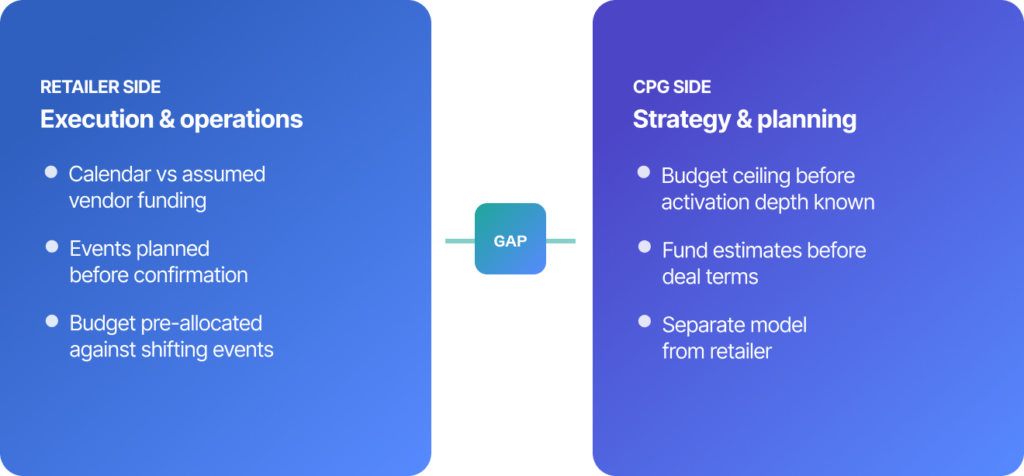
The downstream consequences are concrete. A CPG commits a budget ceiling for a retailer account without knowing which promotions will be activated, at what depth, or at what point in the year. The retailer builds their promotional calendar against their own assumptions about available vendor funding. When those assumptions meet — often not until deal negotiation, sometimes not until reconciliation — the delta between them becomes fund leakage. Dollars committed to one promotion are unavailable for another. Category growth opportunities that could have been funded are missed because the budget was already allocated against events that may shift, shrink, or disappear entirely.
The investment did not go to waste in any single dramatic failure. It quietly went to the wrong place.

A structural problem that discipline alone cannot fix
Retailers and CPGs both want profitable promotions — what neither side sees clearly is that the other wants the same thing, and that mutual misread shapes every planning conversation that follows.3
What makes the assumed dollars problem persistent is that it is not primarily a process failure. It is an architecture failure. CPGs and retailers have historically planned in separate systems that were not designed to surface shared data or inform each other’s decisions in real time.
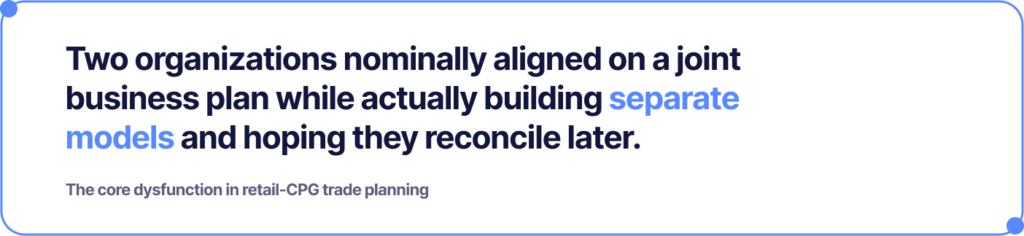
The CPG manages their trade fund commitments. The retailer manages their promotional calendar. Neither has visibility into what the other is working from at the moment it matters most — before the plan is finalized. The result is two organizations that are nominally aligned on a joint business plan while actually building separate models and hoping they reconcile later.
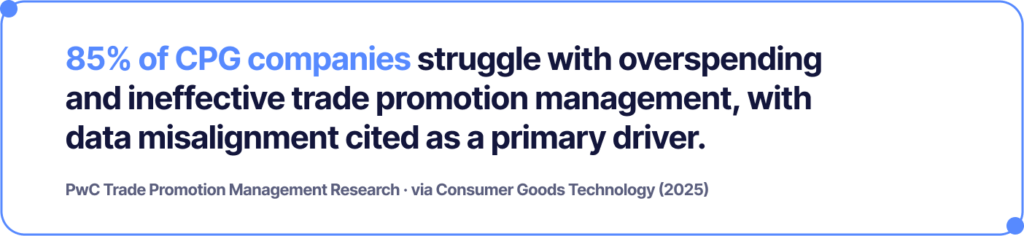
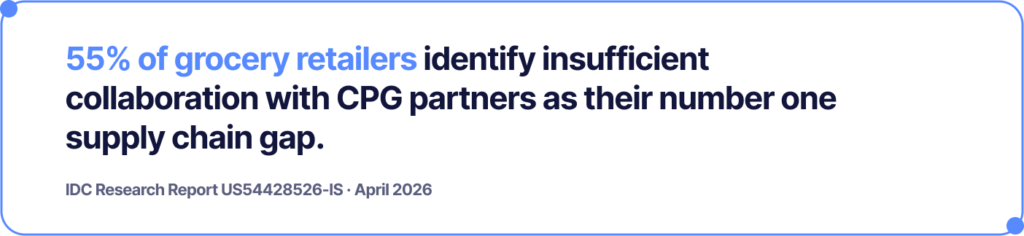
These are not isolated execution challenges. They are the predictable output of a planning architecture that was never designed for genuine joint visibility.
The co-planning workspace: a different starting point
The fix is not more discipline applied to the existing process. It is a different process architecture — one that changes where alignment happens, not just how well it is managed after the fact.
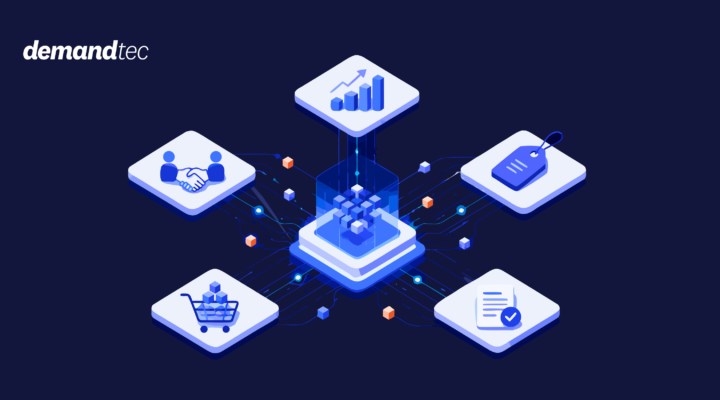
A co-planning workspace brings retailers and CPG partners into a shared planning environment before assumed dollars are committed. Both parties work from the same demand signal, against the same promotional calendar, with visibility into what the other side is planning and what the data says will drive results.
The plan that emerges is not a vendor proposal that a retailer reviews and modifies. It is a joint plan, built from aligned intelligence, that both sides have a direct stake in executing.
In practice, this looks different from how most joint planning tools operate today. Rather than rebuilding the promotional calendar from scratch each year, the workspace carries forward last year’s events, category structures, and historical performance as a starting baseline — so the first planning conversation begins with shared context, not a blank slate. From there, both sides work against the same live calendar: when a retailer creates an event and selects a CPG partner, a structured invitation goes out directly. The account manager can see the event scope, the category, and the timing, and respond with a deal. That invitation-to-deal workflow is captured in one place, so both sides can see at any point which promotions are funded, which are pending, and where the plan still has gaps. The result is not just shared visibility — it is a shared audit trail that makes the assumed-dollars problem visible before it becomes a reconciliation problem.
This kind of bilateral co-planning operates at real scale. DemandTec’s network connects 7,800+ CPG partners across 120+ retail banners, which means the shared workspace is not a theoretical construct. It is a live environment where the invitation-to-deal workflow runs across one of the largest retailer-CPG networks in the industry. A network of that depth took decades to build and cannot be replicated quickly.
The most common objection to shared planning environments is that they require retailer buy-in that is difficult to secure. That framing, however, inverts the actual dynamic. Retailers do not resist collaboration as a matter of principle. They resist unstructured asks for data that carry no clear return. A co-planning workspace changes that calculation. When both sides can see the same demand signal, the retailer is not giving something away — they are gaining a better-funded, better-timed promotion plan. The CPG is not guessing at what the retailer needs — they are building toward shared outcomes. The workspace does not require trust as a precondition. It produces it.
What alignment before commitment changes
When promotional dollars are grounded in shared intelligence rather than prior-year baselines and relationship assumptions, the quality of downstream decisions improves measurably. Events get funded based on what the data indicates will drive category growth, not based on what the historical budget happened to be when planning opened. The gap between committed and actual dollars narrows because the plan was built against genuine promotional intent, not a working estimate that both sides silently hoped would converge.
More fundamentally, the nature of the CPG-retailer conversation shifts. Instead of two parties negotiating over dollars, both parties are building toward a shared commercial outcome. That is the distinction between a co-planning process and a deal submission process — and it is the distinction that determines whether assumed dollars become fund leakage or genuine investment.
For organizations whose joint business planning process still relies on assumed dollars as its primary alignment mechanism, Commercial Trade Intelligence is a practical starting point for identifying where those assumptions diverge — and what it costs when they do.
On June 24, DemandTec is introducing this operating model in full. Download the IDC Snapshot for independent validation of the collaboration gap, or register for the June 24 webinar to see the bilateral platform in practice.
KEY TAKEAWAYS
The assumed dollars problem is the root cause of most trade spend leakage: CPGs commit projected spend before deals are confirmed, retailers build promotional calendars against their own funding assumptions, and both sides work from different models until reconciliation forces a reckoning. This is not a process failure. It is an architecture failure. A co-planning workspace fixes it by bringing both sides into a shared planning environment before assumed dollars are committed, replacing the placeholder with a joint plan built on aligned demand intelligence. DemandTec’s network connects 7,800+ CPG partners across 120+ banners, making this bilateral co-planning live at real scale. The IDC Snapshot provides independent validation of the collaboration gap. The June 24 webinar introduces the full operating model.
FAQ Section
Assumed dollars are the projected promotional spend a CPG expects to commit to a retailer within a planning period, entered before formal deal confirmation. They are a necessary planning estimate, but when both sides treat assumed dollars as a plan and build separate models against them, the gap between those models becomes fund leakage at reconciliation.
Because the problem is architectural, not technological. CPGs and retailers have invested in better tools on each side of the relationship. Those tools are optimized for their own side. Neither has visibility into what the other is working from at the moment that matters most, before the plan is finalized. Better tools on one side do not close a bilateral coordination gap.
A co-planning workspace is a shared planning environment where retailers and CPG partners work from the same demand signal, against the same promotional calendar, before dollars are committed. When a retailer creates an event and selects a CPG partner, a structured invitation goes out directly. The account manager sees the event scope, category, and timing, and responds with a deal. Both sides see which promotions are funded, which are pending, and where the plan has gaps, all in one place.
Commercial Trade Intelligence is the operating model where retailers and their entire CPG network plan, execute, and settle trade from a single shared data layer. Co-planning is one phase of that connected lifecycle. DemandTec is introducing the full category at a live webinar on June 24, 2026.
DemandTec connects 7,800+ CPG partners across 120+ retail banners. Two-sided participation is what makes the co-planning workflow function at scale. A platform with only one side still leaves half the planning conversation happening outside it.