
Key insights from DemandTec-sponsored research reveal a renewed imperative for fast-moving consumer goods (FMCG) retailers to align ambition with retail reality.
Getting prices right has always been a prime directive for retailers of fast-moving consumer goods, but the stakes have never been higher than they are today.
Consumers are more price-conscious than ever. Competition is keener. Market leaders are using refined methods to capture margin and gain share. For all, the urgency to adopt advanced pricing and promotion methods may be the greatest it’s ever been.
Most retailers know this but lack the tools to collaborate internally across the pricing, marketing and merchandising teams. They struggle to find the early pricing wins that help establish a sustained winning process. They neglect to access outside expertise to learn what has worked for others and establish their own best practices.
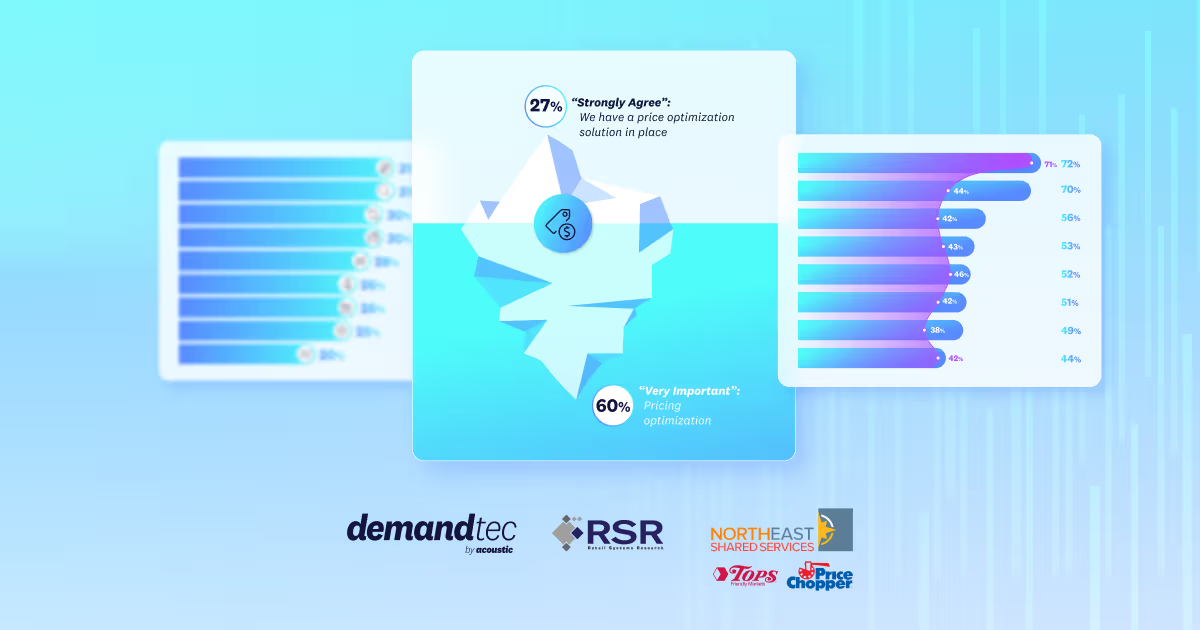
“There’s a wide chasm between what retailers say is important and what they have the capability to do,” said Brian Kilcourse, Managing Partner of RSR Research, commenting on new research commissioned by DemandTec.
“Sixty percent of retailers feel that price optimization is very important. Sixty-two percent of retailers felt that promotion optimization is very important. But there’s a far, far lower percentage of those retailers who say they have implemented those and are satisfied with their solution sets.”
Northeast Shared Services stands out
These important research insights – and more – were shared during a webinar program, Align Ambition With Retail Reality, which featured executives from Northeast Shared Services (NESS), RSR Research, and DemandTec.
The participants discussed research insights that show how FMCG retail winners are using price and promotion to strategic advantage while many others still need to take up the competitive gauntlet. The speakers underscored how a changing consumer mindset is driving a period of rapid change for all.
Headquartered in Schenectady, New York, Northeast Shared Services (NESS) counts itself among those retail winners when it comes to pricing and promotion capabilities, said Richard Mendolera, Director of Business Analytics and Pricing. “We now have almost all center store and fresh UPC-based categories in a production state for price optimization. That’s about 80% of our categories.”
NESS is the parent company of Price Chopper/Market 32 and Tops Friendly Markets, which operates nearly 300 supermarkets across New York, Massachusetts, Vermont, Connecticut, Pennsylvania and New Hampshire. Over the past several years, NESS has deployed DemandTec to innovate in its pricing practices and partnerships, with outstanding outcomes.
He added, “It has significantly helped drive efficiency in my team. We’ve taken the pricing analyst role and actually rounded out those folks into pricing and merchandising analysts. It’s made them better and more efficient at their jobs while supporting the rest of our shared services organization.”
Observed Samuel Walters, DemandTec Sr. Director of Global Consulting, “Another area that we see winners like NESS really do well is determine that best mix of product assortment, pricing, promotions. They align those with the optimal supplier funding levels to ensure that they’re able to execute on their strategy.”
Why the urgency now?
Kilcourse said his firm’s research indicates that adopting pricing and promotion acumen has become more important 2024 than at any other point over the past 5, 10, or 20 years.
“Consumers have consistently told RSR in the 18 years that we’ve been operating that price is the top value attribute that drives their purchase decisions,” he said.
“Most recently, in a study of 1,100 consumers that we did in November 2023, 62 percent said they strongly agreed that prices matter today more than ever, while another 32 percent agreed. So that was 94 percent of all the consumers that we surveyed.”
The hard reality for FMCG retailers is that price is the dominant value attribute, Kilcourse emphasized.
“The giant competitors like Walmart and Amazon are going to win a fair share of their business because they are so aggressive, and they have such big businesses to support price reductions. That means using the data science to compete intelligently with those retailers on price is critical.”
Promotions send a critical message
Diane Colgan, Senior VP of Marketing, NESS, spoke to the inflationary market conditions that today’s grocers are facing. “There are a lot of headwinds facing the grocery retail industry today. There are increased wages, so our costs are going up. And shoppers are looking for more deals.”
She added, “It doesn’t matter if your business strategy focuses more on everyday or promotional pricing. That common consumer need for value and affordability now is even greater than it ever was to build loyalty.”
On the execution side, added Mendolera, NESS also takes pains to align forecasted demand with inventory systems, provide distributions to support those promotions to the stores, and make sure that the right products arrive at the right times.
Observed Kilcourse, “Promotion is the battlefield on which a lot of retailers are currently fighting for the hearts and minds of consumers.”
Localize pricing decisions at scale
In response to an audience question, NESS’s Mendolera outlined how his company maintains numerous price zones spread across the states of New York and Pennsylvania for Tops Markets and further northeast for Price Chopper/Market 32.
“We look at who the competitors are by region and have very targeted guidelines on how we price from a general index standpoint. From a promotional strategy against those retailers, in some areas, we play against some everyday low-price providers. In other areas, we have other promotional retailers that we are up against.”
He said another factor NESS considers is how local brand preferences affect shopper choice, citing an example in the coffee category.
“In the Buffalo area, we love our Tim Horton’s.” While the brand from nearby Canada resonates in Western NY State, he explained that it shouldn’t be priced and promoted the same way further east, where Dunkin’ Donuts or Starbucks may be more top-of-mind.
Taken together, competitive and localization considerations like these add up to a complex set of factors to consider as part of a retailer’s pricing and promotion discipline. Setting the right pricing rules, coordinating plans and making accurate decisions at scale depends on a robust tool set.
Three Steps for Success
Walters enumerated three key steps retailers can take today to implement successful pricing and promotion practices:
Step 1: Collaborate internally across the pricing, marketing and merchandising teams
Step 2: Identify a fast-track path to score early wins that can help drive the process forward
Step 3: Access DemandTec expertise and guidance to learn what has worked for others and pursue implementation that leverages proven best practices.
“There’s a lot more data out there than there used to be,” Walters said. “We’re really in an era where we need intelligent models, intelligent machines to assist us in doing our jobs at the highest level. At DemandTec, we’re tasked with working with you to make the most of that.”
Said Kilcourse, “The time is really now to use the modern data technologies available to retailers to optimize price and promo, and retailers really seem to get it.”
“This is not something that just was plopped on our desktops a few months ago. It’s been around a long time. The science has really been proven.”
He added, “Hopefully everybody who’s been listening knows that now is a good time to get started. Our research showed pretty clearly that the number one inhibitor to progress is organizational inertia – highly siloed processes, for example, between merchandising and marketing.”
“The best way to overcome that is with strong leadership. As Rich mentioned earlier, that leadership at the top really matters. The CEO, that’s the magic card, you know that’s the Queen of Hearts.”
“It’s important to make the right choice in the solution partner. And what I mean by that is, choose a company that isn’t just focused on how cool the technology is.”