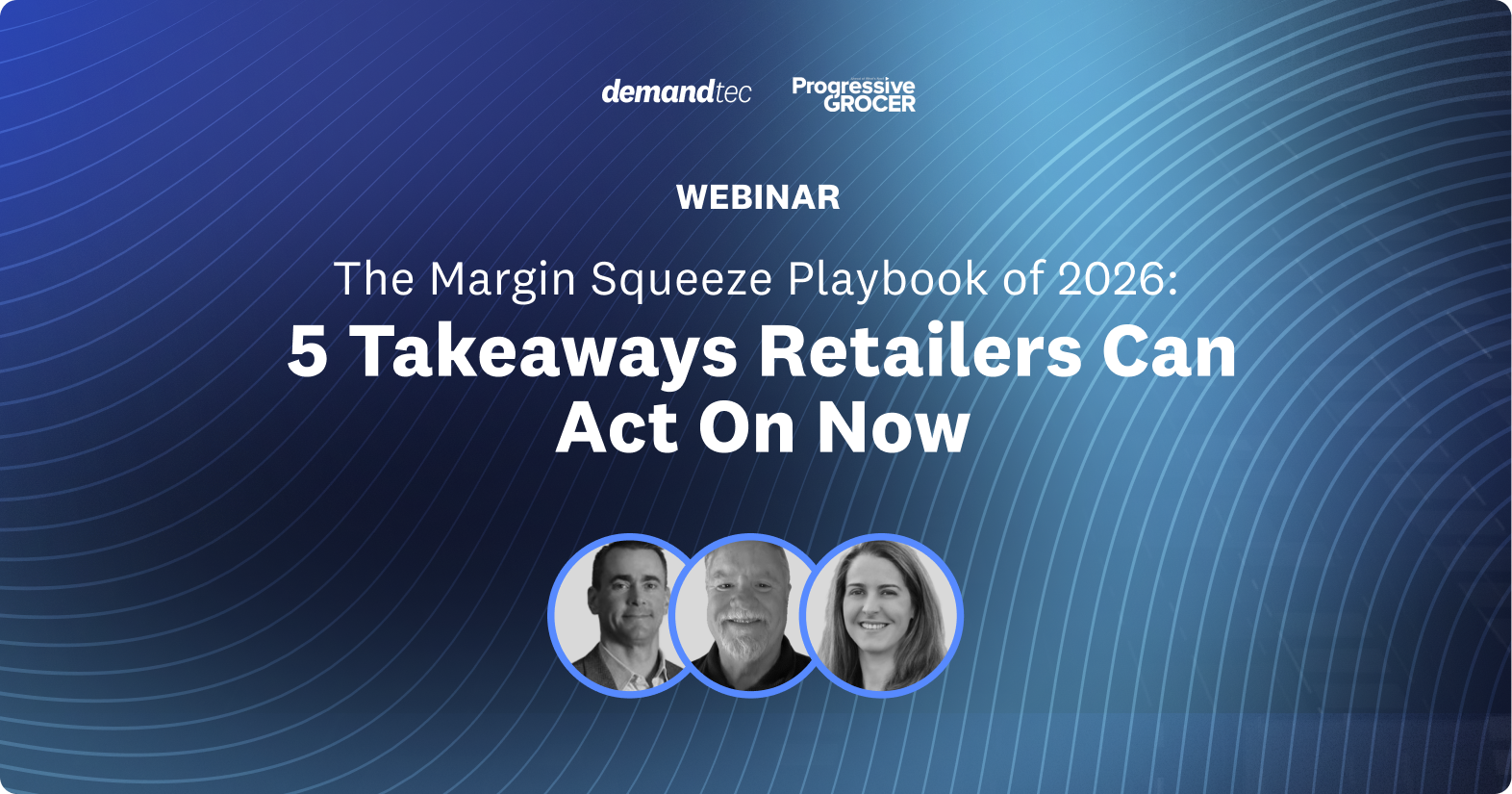
The March 24 Progressive Grocer webinar covered a lot of ground. Fred Cartwright and Eric Odens of DemandTec, joined by Lisa Johnston of Progressive Grocer, walked through where margin pressure is coming from, where leakage hides in the typical grocery operating model, and what it takes to shift from reactive to proactive margin management.
If you attended, this is the distillation. If you missed it, the replay is now available. Either way, here are the five takeaways that matter most, drawn directly from the frameworks and examples the speakers walked through.
1. Margin Pressure Is Permanent, Not Episodic. The Operating Model Has to Match That Reality.
Fred Cartwright opened with a reframe that set the tone for everything that followed. The margin pressure retailers are navigating in 2026 is not a moment in time. It is not a supply shock that will normalize or a tariff cycle that will eventually resolve. It is constant, and the retailers treating it as episodic are designing their response around the wrong assumption.
The practical implication: a planning model built for predictable, periodic adjustments cannot keep up with cost volatility that moves daily and competitive pricing moves that arrive without notice. The operating model has to be built for permanence, not recovery. That is a fundamentally different design requirement than what most grocery organizations are currently running.
2. The Leakage Is in the Handoffs, Not the Decisions.
Eric Odens offered what may be the most useful reframe in the entire session. When margin comes in light, the instinct is to look for the bad decision: the promotion that underperformed, the trade deal that did not reconcile cleanly, the cost change that did not get absorbed correctly.
But most of the time, each decision was defensible in isolation. The pricing team adjusted base price to recover costs. The promotions team ran discounts to protect volume. The trade team funded deals to support supplier goals. Each action made sense on its own. Combined, they quietly cancelled each other out, because no team had visibility into what the others were executing before any of it hit the shelf.
The leakage is structural. It lives in the gaps between functions, not inside any one of them. And according to Eric, that is exactly why it does not show up until weeks after the window to act has already closed.
3. Speed Without Discipline Is Just Faster Leakage. The SaveMart Model Proves the Alternative.
Fred referenced Jim Perkins, president of SaveMart, as one of the clearest examples of how a regional grocer competes against national chains without trying to out-scale them. SaveMart’s operating philosophy, what Perkins calls “heart plus speed,” is built around doing in weeks what once took months, in days what once took weeks, and in some cases in hours what once took days.
But Fred was precise about what makes that speed possible. It does not come from cutting corners. It does not come from removing governance. It comes from alignment: pricing, promotions, and trade funds operating from the same data, in the same connected environment, before execution begins.
When those functions are connected, teams move faster because they are not waiting on data from other systems or resolving conflicts after the fact. When they are not connected, speed just means the leakage accumulates faster.
If you missed the session, the replay is available now. Watch it here.
4. A Shared Forecasting Engine Eliminates the Three Highest-Risk Handoffs.
Eric walked through where the three most dangerous handoffs occur in a traditional grocery operating model: between trade negotiation and promotional planning, between promotional approval and supplier alignment, and between cost changes and trade fund adjustments.
Each handoff creates an opportunity for decisions to be made on misaligned assumptions. A promotion runs at a funding level negotiated before the latest cost change arrived. A supplier and retailer enter a promotional event with different volume expectations. A markdown runs on the same SKU as an active trade deal, with no visibility shared between the teams executing each.
The fix is not better coordination between those three functions after the fact. It is a shared forecasting engine and shared margin assumptions that all three draw from before any decision is executed. One version of the truth, visible to all parties, before execution begins.
5. Margin Protection Becomes a Repeatable Discipline When Decisions Are Connected.
Eric closed the session with a framing worth holding onto. Margin protection does not have to be a quarterly post-mortem or a reactive scramble every time conditions shift. When pricing, promotions, and trade funds operate in a connected environment with shared visibility, it becomes, in Eric’s exact words, “a simple repeatable discipline.”
Teams stop asking who owns the miss after the quarter closes. They start asking how to protect margin together before execution begins. That shift, from reactive accountability to proactive alignment, is the operational output of lifecycle pricing done right. The live poll results from the session showed that most retailers are still operating monthly or quarterly when it comes to responding to market changes. The gap between that cadence and what the market now demands is exactly the problem lifecycle pricing is built to close.
Conclusion
The session came back to one central argument: margin leakage is not a talent problem or a strategy problem. It is a coordination problem, and it concentrates in the handoffs between decisions that each looked reasonable on their own.
The retailers closing that gap are not working harder. They are connecting the systems that connect the decisions, and building margin protection into the operating model rather than the post-event review.
The full replay is now available on demand. If the patterns above look familiar in your organization, the Executive Lifecycle Pricing Health Check is the logical next step.
Book your Executive Lifecycle Pricing Health Check.
Key Takeaways / TL;DR
Margin pressure in 2026 is structural and permanent. Operating models built for periodic adjustment cycles are not equipped for the speed and volatility of the current environment.
Margin leakage concentrates in the handoffs between pricing, promotions, and trade funds, not in any one team’s decisions. Each function may be doing its job correctly while the combined outcome quietly erodes margin.
Speed without alignment is not an advantage. SaveMart’s “heart plus speed” model demonstrates that execution velocity comes from connected decisions, not from removing governance.
A shared forecasting engine is the structural fix for the three highest-risk handoffs: trade negotiation to promotional planning, promotional approval to supplier alignment, and cost changes to trade fund adjustments.
When pricing, promotions, and trade funds are connected, margin protection shifts from a quarterly post-mortem to a continuous, repeatable discipline.
FAQ
The session argued that margin leakage in grocery retail is primarily a coordination problem, not a decision-quality problem. Pricing, promotions, and trade funds are typically managed by separate teams in separate systems on separate timelines. Each function may be performing correctly while the combined output quietly erodes margin in the handoffs between them. The session walked through where those handoffs occur, why they produce leakage, and how a connected lifecycle pricing approach closes the gaps.
Fred Cartwright cited SaveMart president Jim Perkins, whose operating philosophy centers on competing as a regional grocer against national chains through speed and local connection rather than scale. Perkins' framework involves compressing decision cycles from months to weeks, weeks to days, and days to hours. The key insight Fred drew from it is that this speed is only sustainable when it is built on alignment between pricing, promotions, and trade, not on reduced governance.
The Health Check is a structured 30-minute diagnostic with DemandTec's Solutions Engineering team. It walks through the specific decision points in your current pricing, promotions, and trade fund workflows to identify where systems are disconnected, where shared context is missing from the evaluation process, and where leakage is most likely concentrating. The outcome is a tiered assessment of where the opportunity is largest and where to prioritize.