Every vendor in the grocery technology market is talking about AI. The claims are loud, they are often vague, and for a Pricing Director or Finance leader evaluating platforms in 2026, they are creating more noise than clarity.
The question is not whether AI matters in trade fund management. It does. The question is what conditions have to be in place for AI to actually work, and whether your current environment meets them.
IDC has a direct answer.
The Framework That Cuts Through the Noise
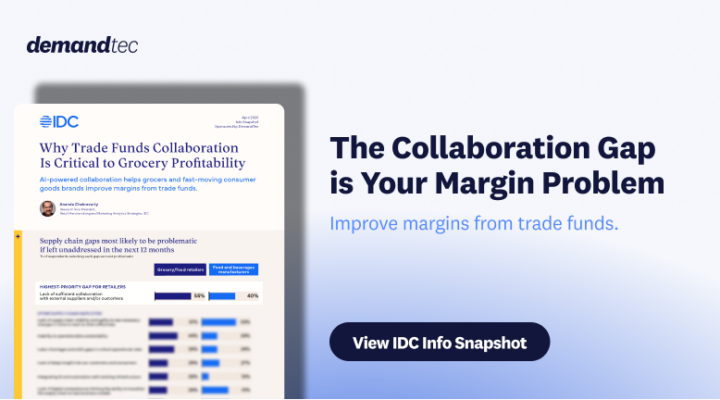
The collaboration gap between retailers and CPG partners is the industry’s acknowledged top supply chain risk. Fifty-five percent of grocery retailers named it as their number one challenge in IDC’s research. (IDC Supply Chain Survey, 2025, n=43 grocery and food retailers. IDC Info Snapshot US54428526-IS, Ananda Chakravarty, Research Vice President, Retail Merchandising and Marketing Analytics Strategies, IDC, April 2026.) The question Blog 1 left open is what the solution architecture actually looks like.
IDC’s research provides a two-part answer.
The foundation is automation. Per IDC Info Snapshot US54428526-IS (Ananda Chakravarty, Research Vice President, Retail Merchandising and Marketing Analytics Strategies, IDC, April 2026): “Automated workflows and integrated forecasting are required to achieve the control, stability, and execution to strike effective, intelligence-driven trade fund deals.”
That is not a vision statement. It is a diagnostic. Retailers managing trade funds through manual processes and disconnected systems will not gain control by adding AI on top of that environment. They will get faster wrong answers. The workflow discipline has to come first.
The ceiling is AI. Once automated workflows and integrated forecasting provide the control layer, AI can simulate complex trade interactions, offer intelligent recommendations, and enable autonomous decision support. This is where real competitive advantage lives. Not in AI as a feature, but in AI operating on clean, automated, real-time data from both sides of the trade relationship.
The sequence is not optional. Neither layer works without the other in order.
IDC’s full research covers how this automation-to-AI architecture maps to best-in-class trade fund performance. Download the Snapshot here
How to Evaluate Any Vendor Making AI Claims
This framework gives buyers a more useful question than “do you have AI.” The right question is: what is your AI operating on?
A platform that has not solved the automation and workflow discipline problem first is selling AI as a feature layered on top of a manual process. Trade spend represents 15 to 25% of gross revenue for most retailers. Seventy-two percent of U.S. trade promotions lose money. The cost of AI operating on fragmented, unstructured trade data is not hypothetical. It shows up in disputed claims, missed accruals, and fund overspend that surfaces too late to correct.
A platform that has solved the automation layer first, and built AI on top of that foundation, is a different category of tool. It is not adding intelligence to a broken process. It is adding intelligence to a controlled one.
For Pricing Directors and Finance leaders evaluating platforms in an RFP cycle, the automation layer is the qualifying question. If a vendor cannot describe how trade fund workflows are automated, how accruals are calculated dynamically during execution, and how integrated forecasting connects pricing, promotions, and trade fund decisions before commitment, the AI capabilities built on top of that are theoretical.
Why the CPG Relationship Is Where This Becomes Real
The two-part IDC framework is not abstract. It is a description of what the retailer-supplier trade relationship actually requires to function at the performance level grocery leadership expects.
As Ananda “Andy” Chakravarty, VP Research, IDC Retail Insights, writes in IDC Info Snapshot US54428526-IS (April 2026, sponsored by DemandTec): “Every retail executive understands the dependency on suppliers and CPGs. There is inherent value in ecosystems and improving dynamic supplier collaboration can translate into bottom line impacts.”
That dependency is the reason the automation foundation matters as much as it does. A retailer building toward AI-enabled trade execution is not just optimizing an internal workflow. It is building toward a shared execution environment where supplier-side data, fund availability, and deal performance are visible to both parties before commitments are made. The AI ceiling is only reachable when the collaboration layer beneath it is automated, connected, and operating in real time.
DemandTec’s Position in This Architecture
DemandTec delivers both layers in the sequence IDC describes. Trade fund workflows are automated across the full lifecycle: fund creation and allocation, promotion commitment with automated fund reservation, dynamic accruals that update during execution, and clean reconciliation with post-event ROI analysis. That is the automation floor.
On top of that foundation, DemandTec’s demand science evaluates the financial performance of a trade deal the moment it is submitted, before a single dollar is committed. No other collaboration platform sits on top of a promotions and pricing engine at the same time. With 7,800-plus connected CPG partners and 25 years of demand science, the network and analytical foundation are already in place.
That is the ceiling IDC describes. Built on the floor IDC requires.
Read the Research
The IDC Snapshot delivers the full picture: the survey findings, the automation-to-AI framework, and the benchmarks separating best-in-class trade execution from the rest.
Download the IDC Snapshot here
Key Takeaways / TL;DR
IDC’s research establishes a clear two-part framework for trade fund performance: automated workflows and integrated forecasting are the required foundation, and AI is the capability layer that becomes available once that foundation is in place. Retailers adding AI on top of manual, fragmented trade fund processes will not close the collaboration gap. They will accelerate the errors already present. The right question when evaluating any platform is not whether it has AI but what the AI is operating on. DemandTec delivers both layers in the sequence IDC describes, on a platform connected to 7,800-plus CPG partners with the network and demand science to make the ceiling reachable.
FAQ Section
In IDC Info Snapshot US54428526-IS (Ananda Chakravarty, Research Vice President, Retail Merchandising and Marketing Analytics Strategies, IDC, April 2026), IDC identifies automated workflows and integrated forecasting as the foundational requirement before AI can deliver value in trade execution. AI layered on top of manual, disconnected processes does not close the collaboration gap. Workflow discipline comes first.
The automation foundation refers to the workflow infrastructure required to manage trade funds with control and visibility: structured fund allocation, automated fund reservation at the point of promotion planning, dynamic accruals that update during execution, and a clean reconciliation trail from commitment to settlement. Without this layer in place, trade fund data is too fragmented to support reliable AI recommendations.
Once automated workflows and integrated forecasting provide the control layer, AI can simulate complex trade interactions across retailers and CPG partners, offer intelligent recommendations on fund allocation and promotional investment, and enable autonomous decision support that reduces the manual burden on Finance and Merchandising teams.
The qualifying question is not whether a platform has AI. It is what the AI is operating on. A platform that cannot describe how trade fund workflows are automated, how accruals are calculated dynamically, and how integrated forecasting connects pricing, promotions, and trade decisions before commitment is selling AI as a feature on top of a manual process. That is not a ceiling. It is a claim.
AI-enabled trade execution requires data from both sides of the trade relationship operating in real time. A retailer building toward the AI ceiling needs a collaboration environment where supplier fund availability, deal terms, and performance data are visible and structured before commitments are made. Without that shared data foundation, AI recommendations reflect only one side of a two-sided problem.