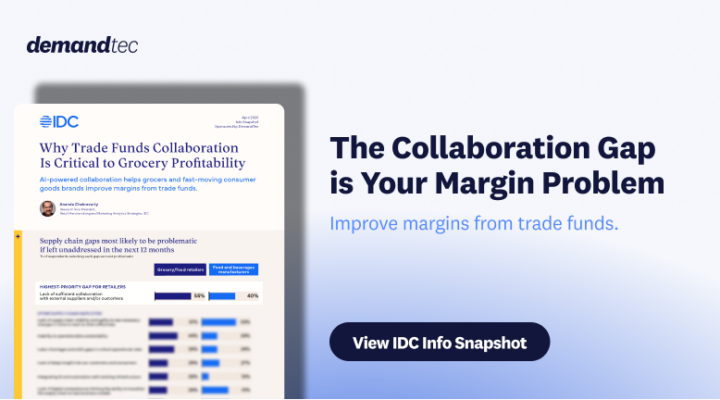
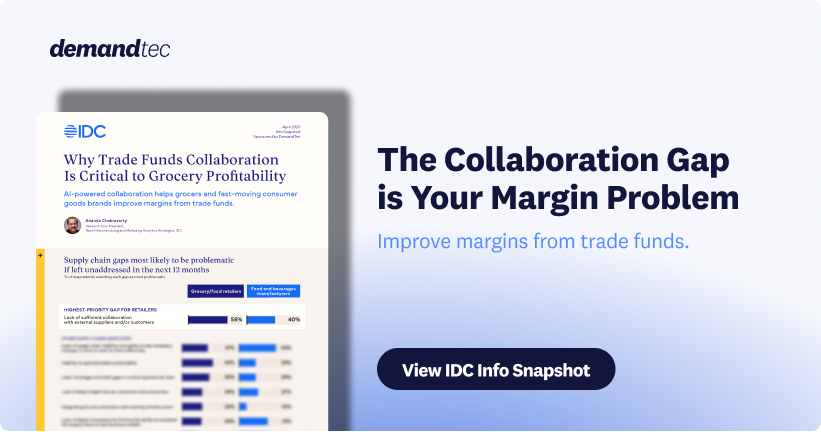
IDC asked 43 grocery and food retailers to name the supply chain gap most likely to hurt their margin in the next 12 months. The answer was not inventory. Not labor shortages. Not AI integration or cybersecurity vulnerabilities.
It was insufficient collaboration with CPG partners. Fifty-five percent of respondents named it as their number one supply chain risk, ranking it above the inability to operationalize sustainability (44%), labor shortages (39%), lack of deep customer insight (29%), and cybersecurity vulnerabilities (22%). (IDC Supply Chain Survey, 2025, n=43 grocery and food retailers. IDC Info Snapshot US54428526-IS, Ananda Chakravarty, Research Vice President, Retail Merchandising and Marketing Analytics Strategies, IDC, April 2026.)
That ranking matters. It is not a vendor claim. It is what grocery operators themselves identified, in a structured survey, as the most urgent threat to margin performance.
What the Collaboration Gap Actually Looks Like
The term “collaboration gap” can sound abstract. In practice, it describes something concrete: trade funds being managed across spreadsheets, disconnected systems, and after-the-fact reconciliations, with retailers and CPG partners working from different data, on different timelines, without shared visibility into whether a deal will perform before it is committed.
Trade spend represents 15 to 25% of gross revenue for most retailers. It is one of the largest investments on the P&L. And 72% of U.S. trade promotions lose money.
That is not primarily a pricing problem or a promotional planning problem. It is a collaboration problem. When fund commitments are made without visibility into how they will perform, when accruals surface at quarter-end as surprises, when claims are disputed because the retailer and CPG partner are reconciling against different records, margin leaks at every handoff.
As Ananda Chakravarty concludes in IDC Info Snapshot US54428526-IS: “Solution-based collaboration between retailers and CPGs around trade deal creation, execution, and reconciliation is now a strategic necessity.”
The retailers and suppliers on the other side of that gap agree. Forty percent of food and beverage manufacturers named the same collaboration gap as their top supply chain challenge. Both sides feel it. Neither can solve it from their own side of the relationship.
IDC’s full research covers what best-in-class collaboration looks like in practice, including the benchmarks separating high-performing retailers from the rest. Download the Snapshot here
Why Adding Technology Does Not Fix It
The instinct when facing an operational gap is to reach for the newest available tool. In the current environment, that tool is AI. But IDC’s research offers a more precise diagnosis.
Automated workflows and integrated forecasting are required first. Per IDC Info Snapshot US54428526-IS (Ananda Chakravarty, Research Vice President, Retail Merchandising and Marketing Analytics Strategies, IDC, April 2026): “Automated workflows and integrated forecasting are required to achieve the control, stability, and execution to strike effective, intelligence-driven trade fund deals.”
Retailers managing trade funds through manual processes and disconnected systems will not gain control by layering AI on top of that dysfunction. The automation and workflow discipline has to come first. Once that foundation is in place, AI can simulate complex trade interactions, offer intelligent recommendations, and enable autonomous decision support. But the sequencing matters.
The collaboration gap is not a data problem that AI can solve in isolation. It is a structural problem that requires both sides of the trade relationship to work from the same foundation.
IDC’s research puts it plainly: “For grocers, an automated, collaborative platform leads to fewer blind spots, faster decisions, and more predictable margin performance.” And at the level of the broader industry: “Connected intelligence between retailers and CPG suppliers is the foundation of profitable growth.”
The Scale of What Is Being Left on the Table
For CFOs and Merchandising leaders benchmarking this against their own operations, the question is not whether the collaboration gap exists in the industry. IDC has established that. The question is whether it exists in their organization, and what it is costing.
A retailer managing 15 to 25% of gross revenue in trade spend through fragmented systems and manual reconciliation is not just accepting inefficiency. It is accepting margin variance as a structural feature of trade operations. Disputed claims, missed accruals, and fund overspend are not edge cases in that environment. They are expected outcomes.
Where DemandTec Fits
DemandTec is the only platform where retailers and CPG suppliers manage trade funds, promotions, and lifecycle pricing in one connected workspace. The moment a trade deal is submitted, DemandTec evaluates its financial performance before a single dollar is committed. No other collaboration platform sits on top of a promotions and pricing engine at the same time. With 7,800-plus connected CPG partners, 120-plus retail banners, and 25 years of demand science, the network and the analytical foundation are already in place.
This is exactly the architecture IDC describes as the path from collaboration gap to margin control.
Read the Research
The IDC Snapshot delivers the full picture: the survey findings, the collaboration gap benchmarks, and IDC’s framework for moving from manual trade fund management toward an automated, AI-enabled execution model.
Download the IDC Snapshot here
Key Takeaways / TL;DR
IDC surveyed 43 grocery retailers and found that 55% named insufficient CPG collaboration as their number one supply chain risk, ranking it above labor, sustainability, and cybersecurity. Trade spend represents 15 to 25% of gross revenue, yet 72% of U.S. trade promotions lose money. IDC identifies automated workflows and integrated forecasting as the required foundation before AI can deliver value in trade execution. The collaboration gap is not a data problem. It is a structural problem that requires both sides of the trade relationship to operate on a shared platform.
FAQ Section
The collaboration gap refers to the disconnect between retailers and CPG partners in managing trade funds, promotions, and deal execution. When both sides operate from separate systems, different data, and misaligned timelines, the result is missed accruals, disputed claims, and trade investments that cannot be traced to margin outcomes.
In IDC Info Snapshot US54428526-IS (Ananda Chakravarty, Research Vice President, Retail Merchandising and Marketing Analytics Strategies, IDC, April 2026), IDC found that 55% of grocery retailers named insufficient CPG collaboration as their number one supply chain gap. Forty percent of food and beverage manufacturers identified the same problem.
Industry data shows 72% of U.S. trade promotions lose money. The primary cause is not promotional planning in isolation. It is the absence of shared visibility between retailers and CPG partners at the point of commitment. When trade fund decisions are made without integrated forecasting and aligned data, the investment cannot be optimized before execution begins.
IDC's research identifies automated workflows and integrated forecasting as the foundational requirements, followed by AI-enabled decision support once that automation layer is in place. The sequencing matters: AI layered on top of manual, fragmented processes does not close the gap.
DemandTec connects trade fund management, promotion optimization, and lifecycle pricing on a single analytical foundation. Most platforms serve only one side of the trade relationship. DemandTec is the only platform where both retailers and CPG suppliers manage trade funds together, with deal performance evaluated before commitment, not after.